
Startup Salary Negotiation - How to Negotiate Startup Compensation
If you’ve recently decided to pursue a job at startup company, then this startup salary negotiation guide is for you. Working at a smaller fastest-growing company is in high demand, so if you’ve been fortunate enough to land a job offer with a startup then we can help you make sure it’s competitive before accepting.
Our goal in this startup compensation guide is to make sure you don’t accept the first startup offer and instead increase the compensation package through the startup salary negotiation process.
Startup offer negotiations are both incredibly common and can lead to huge increases in the compensation over the course of your career. We are going to share the insights and strategies that have helped hundreds of career professionals just like you secure improved compensation packages. We will walk you through exactly how to prepare for and navigate a startup salary negotiation so that you can receive competitive startup compensation.
Want to Negotiate Your Offer? Get offer-specific guidance from a Salary Negotiation Coach. We help career professionals negotiate competitive job offers.
Or leverage our Salary Negotiation Courses and Salary Negotiation Templates.
 Job Offer Negotiation Course
- Get our job offer negotiation strategies, templates, scripts, and guidance.
- Access our step-by-step lessons, compensation research guides, and tools.
- Access Now
 Raise Negotiation Course
- Get our raise negotiation strategies, templates, scripts, and guidance.
- Access our step-by-step lessons, compensation research guides, and tools.
- Access Now

Guide to Startup Compensation Components
A successful salary negotiation with a startup will be impossible if you don’t have a clear understanding of what’s included in your startup compensation package. This means evaluating all elements that contribute to your total compensation at startup, and not just the base salary.
For example, most job offers at a startup include a wide range of compensation components, including base salaries, bonuses, equity packages, and sign-on bonuses. When it comes to startup offer letters specifically, the total compensation that you receive will usually be split across the following compensation components:
STARTUP BASE SALARY
STARTUP BONUS
STARTUP EQUITY PACKAGE
STARTUP SIGN-ON BONUS
STARTUP STOCK REFRESH
The average total compensation for a startup software engineer salary might look like the following:
STARTUP SOFTWARE ENGINEER SALARY
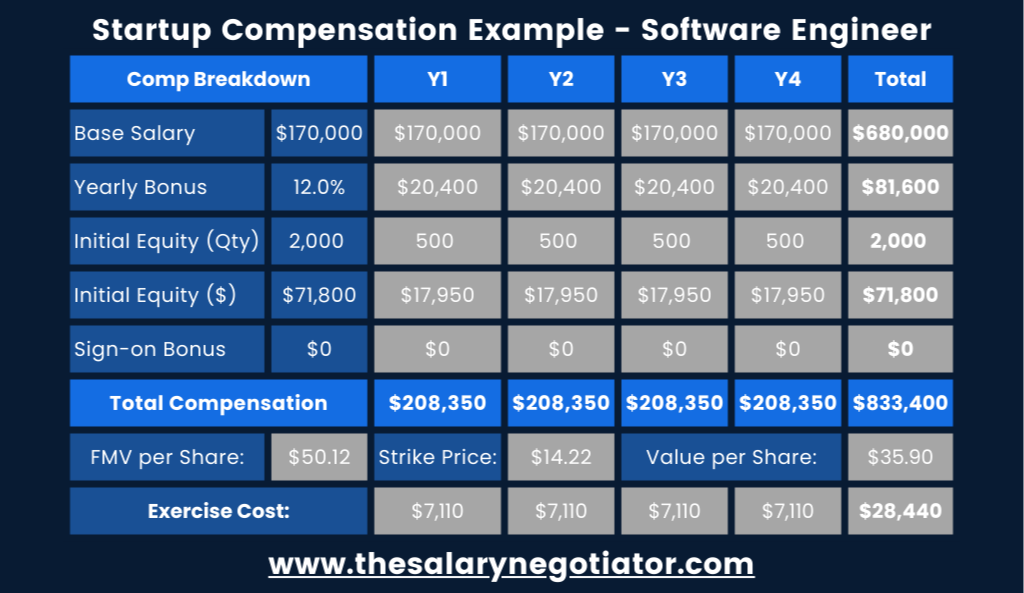
So why is the startup offer evaluation process so important? When you have a solid understanding of each compensation components, you can calculate your total annual take home pay accurately before negotiating. That way you increase all components during the salary negotiation with startup.
Keep reading and we will break down the most common elements of a startup compensation and benefits package in detail – including startup equity which is one of the main reasons to work at a startup.
STARTUP BASE SALARY
Let’s start with the startup compensation component you’re probably most familiar with – base salary. The startup base salary is the guaranteed fixed pay you receive in exchange for the work you do and it will stay the same unless you receive merit increases or a promotion.
Like most salaried roles, a startup will have a fixed base salary range for each of their specific roles and the base salary at a startup that you’re offered can fall anywhere between that designated range. For example, the base salary range for a startup senior software engineer salary will look different from the range for a startup staff software engineer salary. The same is true even for startup compensation packages at the same level. For example, the pay ranges for a startup senior product designer salary will differ from the ranges for a startup senior product manager salary.
Startup’s will usually issues their initial offers at the lower to mid-end of the base salary range for your role, so it’s important to negotiate for higher startup base pay.
STARTUP BONUS
Your startup offer package might also include an annual bonus. Similar to the target bonuses in a Meta offer letter or Google offer letter, the startup bonus structure can be based on either personal or company performance and is calculated according to a percentage of your startup base salary.
A bonus at a startup can range between 10-50% depending on startup salary levels, role types, and departments (i.e., the bonus for a startup engineering manager salary could be higher than that for a startup data scientist salary). Receiving a startup bonus in your compensation package is a major win given job offers at some companies, like what you’d see in a Netflix offer letter or Nvidia offer letter, do not include this type of bonus.
While the startup bonus percentages are usually non-negotiable, remember that the bonus itself is usually calculated based on your base salary. So the higher you negotiate the startup base salary, the higher your bonus at a startup will be.
STARTUP EQUITY PACKAGE
Many career professionals seek startup companies because of the opportunity to receive startup equity compensation in a private company.
Startup equity compensation most commonly comes in the form of employee stock options but you may also see restricted stock units (RSUs) at later-stage startups or companies preparing to go public.
Startup RSUs
Startup RSUs represent actual shares of the company that you receive once they vest. When RSUs vest, you own the shares outright without needing to purchase them. This structure is more common at large public companies like Amazon or Google and less common at early-stage startups because private companies often lack liquidity.
Startup Stock Options
Startup stock options on the other hand give you the right to purchase company shares at a predetermined price known as the exercise or strike price. To turn startup stock options into actual shares you then must pay this exercise price. Startup stock options are the most common form of startup equity compensation at early and mid stage startups.
At the time startup options are granted, their current value may be small or effectively $0. This is because the exercise price is typically set equal to the company’s current fair market value which is often determined by a 409A valuation. The potential value of startup stock options comes from any future growth where if the startup’s value increases above your exercise price then the difference will represent your potential gain.
Startup Vesting Schedule
Startup equity grants also come with a startup equity vesting schedule which means you earn ownership of the startup equity compensation over time rather than all at once. Most startup vesting schedules last three to four years with equity vesting in regular or staggered increments. Here are two example startup vesting schedules to give you a visual:
| Company | Vesting Period | Year 1 | Year 2 | Year 3 | Year 4 |
|---|---|---|---|---|---|
| Company A | 4 years (equal) | 25% | 25% | 25% | 25% |
| Company B | 4 years (staggered) | 38% | 32% | 20% | 10% |
If you leave the company before your startup equity compensation fully vests then you will forfeit those unvested portions. You might also be tied to a startup exercise window which is a period where you need to exercise your vested options after leaving a company before they expire.
It’s important to remember that startup equity compensation does carry additional risk for your compensation. If the startup grows and its valuation increases, your startup equity compensation may become more valuable. If the startup struggles or fails then the startup equity compensation may never have liquidity or meaningful value.
Startup equity negotiation is often one of the most impactful areas to focus on in startup offers and it’s where we usually see the largest upside when negotiated correctly. However, you’ll still want to negotiate all total compensation components at a startup together.
STARTUP SIGN-ON BONUS
You should also be eligible for a startup signing bonus, but receiving a sign-on bonus at startup it usually requires strategic negotiation. That’s because startups are more protective about their cash compared to larger companies.
A startup sign-on bonus is a one-time hiring bonus you could receive to incentivize you to join startup and to make up for any lost bonuses or unvested equity at your former company. However, even if you are not walking away from money at your current company or you’re currently unemployed, we’ve still had success securing startup sign-on bonuses. So don’t consider that you won’t receive a startup sign-on bonus unless you use our strategies to try to secure one.
STARTUP STOCK REFRESHER
Many startup companies will offer a startup stock refresher (essentially more startup equity packages) annually. With that being said, we don’t include startup stock refreshers in our total compensation calculation because companies at that level are typically unwilling to share the expected yearly amount for a startup stock refresher. These can be based on performance or other metrics so it makes it difficult to know how much you’ll receive until you actually reach each startup equity refresher.
However, we still encourage you to ask the recruiter about the startup stock refresher to build negotiation leverage.
STARTUP EMPLOYEE BENEFITS AND PERKS
A startup compensation package will hopefully include decent startup employee benefits and perks – such as health benefits, a startup 401k match, family leave, unlimited PTO, learning stipends, and other cool perks that you’d expect from a up an coming company.
However, startups are often still early in their growth which means their startup benefits and perks may not be as competitive as those at more established companies. For example, they may not yet offer a startup 401K match or provide some of the benefits you’d expect at a larger organization. Because of this it’s important to review a startup’s benefits package before negotiating so you understand the full picture.
While we’ve found that startup benefits and perks are typically non-negotiable, we do still recommend asking about them during the due diligence phase of the startup salary negotiation process. Startups are often more flexible than larger companies when it comes to startup benefits and perks so this is a key step in both seeing where there is flexibility and building leverage during the startup salary negotiation.
Startup Salary Negotiation Steps
Look, there’s a lot of bad startup salary negotiation advice out there. Our goal is to give you proven strategies that actually work with startups, backed by hundreds of real salary negotiations. These steps are based on years of successful outcomes and are designed to help you navigate the startup compensation negotiation process so you can maintain a positive relationship with the hiring team and secure competitive pay.
While these steps are key to a successful startup salary negotiation, working with a Startup Salary Negotiation Coach or taking our Offer Negotiation Course will provide all of our strategies and tools to help you navigate the negotiation process correctly.
1) UNDERSTAND THE COMPONENTS OF STARTUP SALARY
If you’ve been following along so far you should already have the first step to a successful startup salary negotiation complete – understanding each of the components in a startup salary package.
The main goal here is to make sure you’re clear on your startup total compensation before trying to negotiate a startup offer package. If you need help with this step then we highly recommend using our Total Compensation Tool to help with your startup compensation calculation and research.
- Understand Total Compensation – Use our tool to break down and calculate the compensation in your job offer.
- Research & Compare Offers – Organize your compensation research and determine the right counter amount.
- Get Here
2) COMPLETE DUE DILIGENCE BY ASKING STRATEGIC QUESTIONS ABOUT STARTUP OFFER LETTER
Next, you will want to begin asking strategic questions to the recruiting team to ensure you have all the startup offer letter and benefits information. This step is all about building leverage before you start the startup comp negotiation and it helps by:
Gaining the insights needed to develop a strong startup counteroffer
Highlights to the hiring team that you are completing your startup offer evalaution and not coming out of nowhere when you do ask for better comp
If you skip this step, your startup counteroffer won’t be as effective and you might be missing important components. The goal here is to show the recruiting team that you're doing your research and carefully evaluating the startup career opportunity. This demonstrates that your request for better pay is well thought out and justified to the startup recruiting team instead of just sounding like “I just want more money”.
You can use our Strategic Questions to Build Negotiation Leverage if you don’t know the right questions to ask. We also highly recommend beginning this step within the first 24-48 hours of receiving your startup offer letter to ensure the hiring team knows you are working toward accepting the role.
- Build Negotiation Leverage – Ask the right questions to strengthen your negotiation before sending a counter.
- Email & Phone Scripts – Get our list of questions to ask and what to say if the recruiter wants to chat through them.
- Get Here
3) RESEARCH STARTUP COMPENSATION
It’s essential that you take the time to research startup compensation data so you can determine the strength of your initial startup salary and identify how much you should counter for.
As we explained earlier, startup compensation structures are generally dictated by set salary ranges for each individual role – meaning your research must be specific to your exact level and position. You wouldn’t want to come to the table with data on a startup software engineer salary if your offer was actually for a senior software engineer salary at startup.
Sites like PayScale and others can be great resources for this startup compensation research. However, keep in mind that the salary ranges on public sites like these and blogs are often self-reported by current or former employees, so they may not reflect the most up-to-date offers for startup new hires. This is especially true given the changes in compensation from year to year due to the equity component (i.e., if you see high comp data on startup Levels fyi it might be due to equity appreciation and not what they typically offer a new hire).
For the most accurate data, we recommend cross-referencing pay data across multiple platforms for startups. We created our Total Compensation Research Comparison Tool to help you streamline your salary research and effectively analyze pay ranges for your role in this step.
- Understand Total Compensation – Use our tool to break down and calculate the compensation in your job offer.
- Research & Compare Offers – Organize your compensation research and determine the right counter amount.
- Get Here
4) SEND STARTUP COUNTEROFFER TO HIRING TEAM
Now that you have your startup compensation research in hand, you should be ready to develop a strategic startup counteroffer and send it to the hiring team.
The goal of this step is to take a data-based approach and not just reiterate what you would bring to the team – remember, the hiring team already knows the skills you bring to the table which is why you received a job offer from the startup.
We highly recommend sending your startup counteroffer through email to reduce the risk of going off topic on a call. Email also gives the hiring team at the startup something accurate and tangible to share and review with the decision makers.
So what should you include in your startup counteroffer? Begin by respectfully communicating how the benefits in your initial offer differ from other companies and/or your current role offer. You should then reference the top end of the startup pay ranges you’ve gathered and that you should be paid in line with the top end of those ranges.
It’s key to have proper communication in your startup counter offer so you can use our Counteroffer Email Templates if needed to help you with your strategic startup counteroffer.

- Proven Counteroffer Templates – Built from hundreds of successful job offer negotiations.
- Negotiate with Confidence – Remove the guesswork with our professionally crafted counteroffers.
- Get Here
5) HANDLE STARTUP COUNTEROFFER PUSHBACK
Finally, once you’ve sent over your startup counteroffer you will want to prepare yourself for some pushback from the recruiter or hiring team.
In most cases, the recruiting team will come back saying that they can’t make any increases or changes to the startup offer package. Don’t be worried if this happens as it’s a normal part of the startup salary negotiation process. Instead, simply respond professionally by stating you understand their constraints, but ask again if they could take your startup counteroffer back to their comp team for one last look (like how we explain in our Counteroffer Objection Handling Scripts). You should still ask even if they insist their team will just say no.
- Overcome Recruiter Pushback – Proven scripts to handle pushback and keep your salary negotiation on track.
- Communicate Effectively – Use expert responses to get recruiters to advocate for you with the compensation team.
- Get Here
After taking your thoughts back to their team, they should return with an improved startup offer letter. If the updated startup compensation package aligns with your goals and the startup salary bands you researched, then you should be ready to send over our Offer Acceptance Email to document it and lock it in!
- Accept or Decline – Expert crafted job offer acceptance email and rejection email templates to share your decision.
- Professional & Genuine Tone – These help you communicate in a professional manner regardless of what you decide.
- Get Here
Startup Compensation Negotiation Mistakes to Avoid
As we mentioned earlier, there's a lot of bad advice out there from career coaches and ex-recruiters who haven’t actually managed hundreds of salary negotiations. Our goal is to help you cut through that noise and navigate your startup compensation negotiation the right way.
We’ve outlined the most common mistakes to avoid in a startup offer negotiation below. While these tips are valuable and will help you, we still recommend working with a Salary Negotiation Coach or taking our Job Offer Negotiation Course to ensure you steer clear of pitfalls in your startup salary negotiation.
Avoid Sharing Startup Salary Expectations Before Getting a Startup Job Offer
Look – the startup knows how much they can pay for their roles and by telling them your startup salary expectations it is not going to guarantee a certain outcome. That’s a fact so don’t think you’re negotiating when sharing startup salary expectations.
For example, if you share a lower startup principal engineer salary expectation with the hiring team than what they could offer, they will then be motivated to offer you that lower startup compensation or down level you (yes, down-level – very common at tech companies). On the other hand, if you answer with a number higher than what they are able to realistically offer for a startup principal engineer salary, they could become disinterested and decide to go with a different candidate.
Sharing your salary expectations before you have a startup job offer in hand makes it more difficult to receive a competitive startup compensation package in almost all cases – whether you share these details verbally or on job applications.
However, you should prepare yourself for pressure from the recruiting team because they will ask this and there is a right and wrong way to respond. We provide our Salary Expectation Responses for you to use so you can overcome their tactics and hopefully secure a competitive startup initial offer.

- Salary Expectation Responses – Scripts to overcome recruiter salary expectation discussions and pre offer calls.
- Avoid Lowballing Yourself – These call scripts and email templates will help you get a competitive offer.
- Get Here
Be Realistic By Doing Startup Comp Research
It’s easy to jeopardize a relationship with the hiring team by coming off as too aggressive, especially with a startup, so make sure that you don’t push for unreasonable compensation at startup.
Even though some startup’s pay well, you don’t want to negotiate for something that’s unrealistic and they cannot offer for your specific role. That’s why it’s so important to take the time to understand each element of your startup compensation package and research the startup pay ranges for your specific role. With the right data and insights, you should be able to come up with an appropriate and effective startup counteroffer.
Don't Be Afraid of a Startup Salary Negotiation
The worst mistake you could make? Not negotiating a startup offer letter at all.
Negotiating a startup offer after the interview process can feel incredibly intimidating, especially if you’ve never done it before. But in reality, there’s nothing to worry about. You’re not going to lose out on your startup offer letter because of an attempted startup salary negotiation. We’ve helped facilitate hundreds of successful tech salary negotiations and we’ve never seen a company take back a job offer because a candidate tried to negotiate by following our strategies.
Regardless of the role level – whether it’s a startup data scientist salary or a Startup SWE salary – you should negotiate your startup job offer. Don’t ever let salary negotiation fears keep you from advocating for competitive compensation at a startup.
Most Common Questions About Startup Equity Negotiations
Career professionals often ask us these questions about a startup equity negotiation so we’d like to share our insights with you.
Can startup equity be negotiated?
Yes, it just takes the right startup equity negotiation strategies to get a startup to adjust their offer package. Negotiating a startup salary is not only possible, but it’s recommended by our salary negotiation coaching team. If you approach the startup equity negotiation with the right strategies then you should receive a more competitive startup equity compensation before starting the new role.
Do startups let you negotiate salary?
Startups will use a lot of tactics to deter you from negotiating a startup offer, but tall of the comp components can be negotiated – base, bonus, startup equity compensation, and sign-on bonuses. You just need to overcome the startups salary negotiation pushback and have a solid negotiation strategy like ours to negotiate startup salary.
How to evaluate startup equity offer?
It’s always important to complete a startup offer evaluation before negotiating. To evaluate a startup equity offer, you’ll first want to review the complete startup compensation package so you understand the compensation components (base salary, bonus, startup equity compensation, and sign-on bonus) and benefits it includes. Then you’ll want to follow a startup salary negotiation like ours to ask the right questions to the hiring team and ensure you’re receiving the best pay.
Do Startups Give a Joining Bonus?
Startups do provide joining bonuses which are usually referred to as a startup sign-on bonus. The startup signing bonus can be harder to secure with a startup since they try to preserve cash more than a larger company, but they are still an item you should be able to secure with the right startup salary negotiation strategy.
Startup Salary Negotiation Coaching & Tools
Increasing startup compensation requires the right salary negotiation strategy. Our expert Salary Negotiation Coaching or Courses and Templates will help you navigate the startup salary negotiation process and secure competitive pay.
Or leverage our Salary Negotiation Courses and Salary Negotiation Scripts.
Job Offer Negotiation Course
- Get our job offer negotiation strategies, templates, scripts, and guidance.
- Access our step-by-step lessons, compensation research guides, and tools.
- Access Now
Raise Negotiation Course
- Get our raise negotiation strategies, templates, scripts, and guidance.
- Access our step-by-step lessons, compensation research guides, and tools.
- Access Now